

“Even the smallest desert carries the silence of a thousand miles.”
When we think of deserts, we usually picture giant landscapes like the Sahara or the Mojave—endless sun, scorching heat, and dunes stretching beyond the horizon. But what if we told you that the smallest desert in the world is not only tiny… but also tucked away in one of the coldest regions of North America?
Yes, the Carcross Desert in Canada breaks every stereotype we associate with deserts.
In this article, we’re diving deep into this tiny wonder—unpacking science, history, myths, climate quirks, and the wild ecology that makes it so unusual.
We’ll explore 6 lesser-known facts that reshape how we think about deserts—and why the world’s smallest desert continues to fascinate geologists, travelers, and nature lovers across the U.S.
Let’s begin.
What Is the Smallest Desert in the World?
The smallest desert in the world is the Carcross Desert, a 2.6-square-kilometer patch of sand in Yukon, Canada. Even though it feels like a classic dune system, geologists insist it’s technically not a true desert—and that’s where things get interesting.
This landscape is shaped by ice-age geology, dry valley winds, and regional microclimates that mimic desert features. That’s why the desert sits at the crossroads of myth and science.
Read Also: How the World’s Deserts Are Changing? 7 Alarming Realities of the World’s Most Extreme Regions
Where Is the World’s Smallest Desert Located?
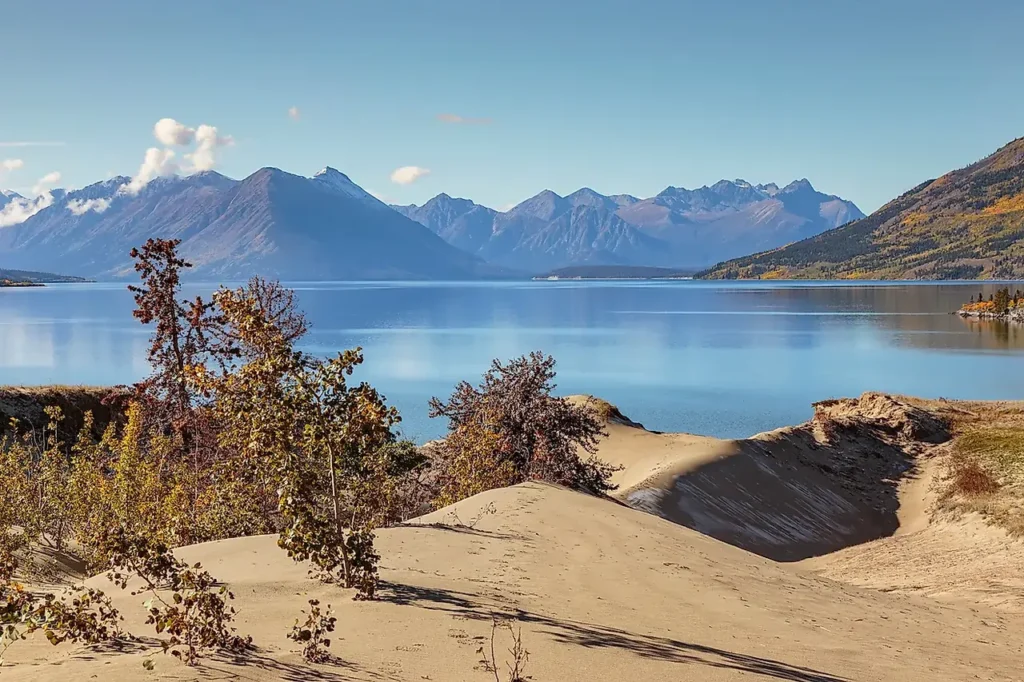
The Carcross Desert lies near the village of Carcross, surrounded by mountain ranges, glacial lakes, boreal forests, and cold northern winds.
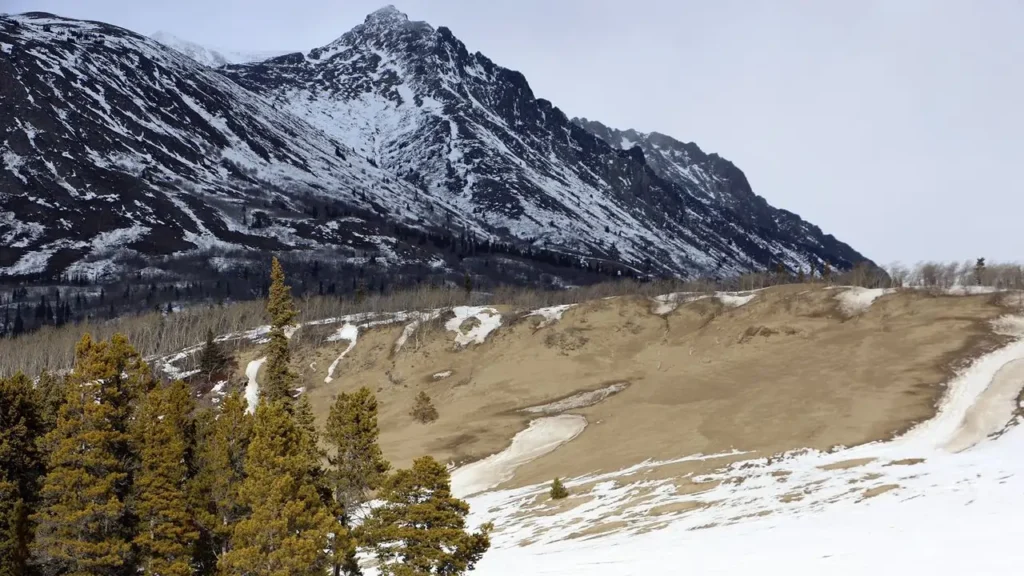
This striking contrast—hot sand surrounded by snow-covered peaks—makes the area feel almost surreal.
How the Desert Was Formed
Geological Origins
When we look at the desert in the world, it’s easy to assume it formed the same way major deserts do. But the Carcross Desert has a completely different birth story—one rooted in ice, water, and powerful ancient forces. Thousands of years ago, this region was submerged under glacial Lake Watson, a massive body of meltwater created during the last ice age. As the lake gradually drained, it left behind thick layers of sand and silt along the valley floor.
These sediments weren’t ordinary beach-like grains—they were finely crushed glacial particles, light enough to be lifted and molded by wind.
Over time, relentless valley winds swept across this exposed terrain, pushing, piling, and sculpting the sand into dune formations. This wind-driven shaping is what ultimately gave the world’s smallest desert its iconic ripple patterns and dune structures.
Why It’s Not a “True Desert”
By scientific climate standards, a true desert must have extremely low annual precipitation. That’s where the contradiction begins. Yukon receives more moisture than classic desert regions, technically disqualifying the Carcross Desert from being a true desert.
However, strong dry winds sweep away moisture so quickly that the surface behaves like the world’s smallest desert—dry, sandy, and barren. This unique mix of moisture plus rapid evaporation is exactly why Carcross occupies a category of its own.
Read Also: 7000-Year-Old Mummies in the Sahara Desert that Don’t Have DNA Similarities with Modern Man
Microclimate Effects
Several localized climate traits combine to produce a desert-like environment within a non-desert region:
- High wind speeds that reshape the dunes
- Low vegetation coverage that is unable to hold moisture
- Rapid evaporation caused by constant air movement
- Fine glacial sand grains that are easily lifted and transported
6 Lesser-Known Facts About the Carcross Desert
Fact 1 — It’s Smaller Than Many U.S. Shopping Malls
When we think about deserts, we normally imagine vast, endless terrains stretching for hundreds of miles. But the smallest desert in the world—the Carcross Desert—defies that mental image completely. In fact, the desert is so compact that many popular U.S. attractions and shopping complexes are either close to its size or noticeably larger.
This miniature landscape measures just 2.6 square kilometers, which makes it feel more like a quirky natural pocket than a sprawling desert ecosystem.
Table 1: Size of the Smallest Desert in the World vs. U.S. Landmarks
| Location / Landmark | Approx. Size | Comparison to the Smallest Desert in the World |
|---|---|---|
| Carcross Desert (World’s Smallest Desert) | 2.6 sq. km | Baseline: the smallest desert in the world |
| Mall of America | 0.5 sq. km | Carcross Desert is 5x larger |
| Central Park, NYC | 3.4 sq. km | Central Park is bigger |
| Disneyland Resort | 2.4 sq. km | Slightly smaller than Carcross Desert |
Read Also: Thrilling Tourist Spots: 15 Mind-Blowing Destinations Built for Pure Adrenaline
Fact 2 — The sand comes from an ancient glacial lake
Unlike the vast dune fields we associate with classic arid landscapes, Carcross has a far more unusual geological origin. Long before the desert became known as the world’s smallest desert, this region was covered by a massive body of water called glacial Lake Watson. As the last ice age ended, the lake gradually drained, leaving behind thick layers of fine silt and sand.
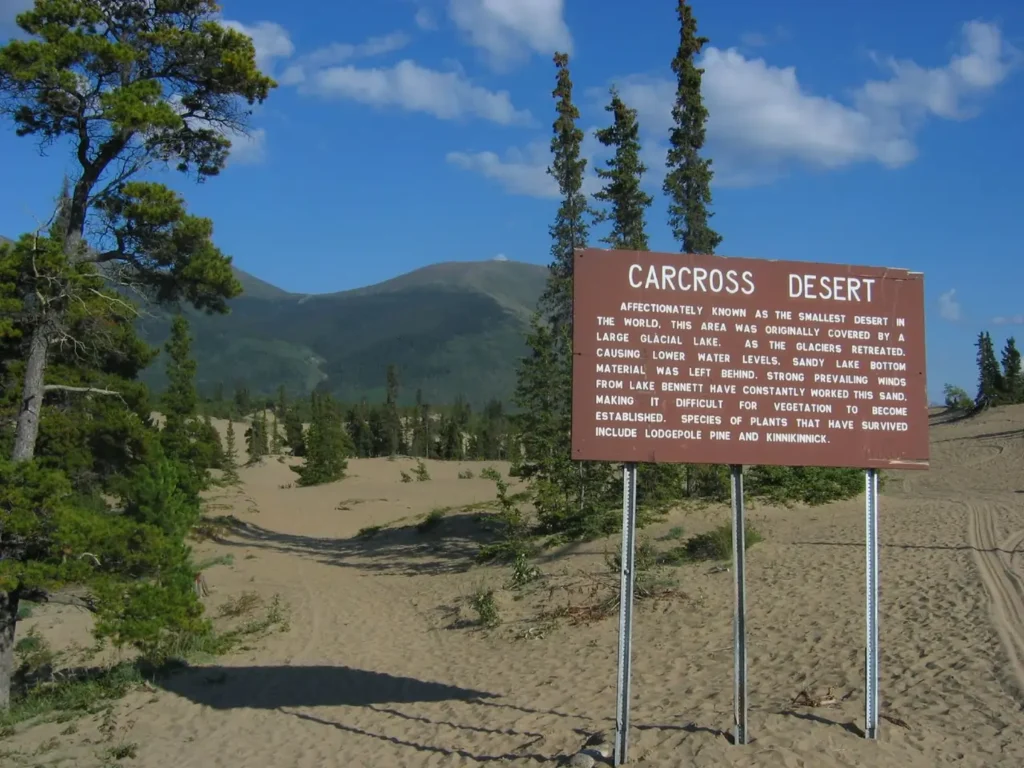
Instead of forming through millions of years of rock erosion under intense heat, the sand of the smallest desert in the world was shaped by ancient glaciers and flowing meltwater. Over time, powerful valley winds swept across the empty lakebed, lifting the loose sediments and sculpting them into dunes. This natural process produced the distinct rippled patterns we still see today in the Carcross Desert, making the world’s smallest desert a fascinating example of how glacial landscapes can mimic true desert environments.
Read Also: 10 World’s Deepest Lakes: The Most Stunning Abyss of Nature
Fact 3 — The Carcross Desert Hosts Rare Plants Found Nowhere Else in the Region
Despite its tiny footprint, the smallest desert in the world shelters an unexpectedly rich ecological community. The Carcross Desert contains several rare and specialized plants that have adapted to survive in this unusual microclimate. These include:
- Baikal sedge
- Yukon lupine
- Dwarf willow
- Rare lichens
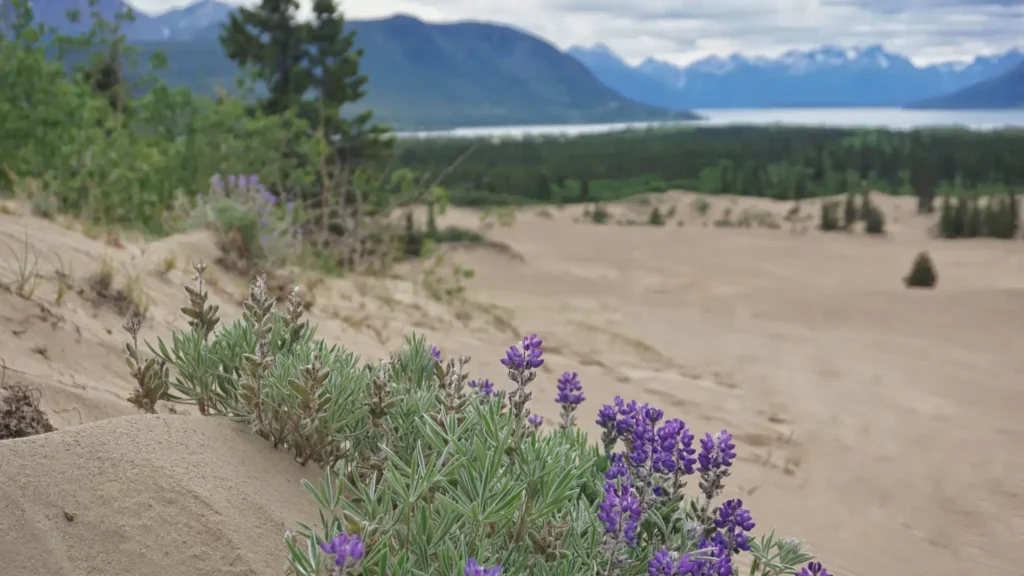
Such species thrive here, even though cold, subarctic forests dominate the surrounding environment. What makes this possible is the way the sand absorbs heat rapidly during summer, creating warm pockets that mimic the conditions of larger deserts. This temperature boost allows the desert to support vegetation that would otherwise struggle in northern climates.
Read Also: 15 Most Unique Trees in the World That Will Leave You in Awe
Fact 4 — It’s a Hotspot for Adventure Sports
Even though the smallest desert in the world looks tiny on a map, it has become an unlikely paradise for thrill-seekers across North America. The world’s smallest desert, better known as the Carcross Desert, offers a rare combination of soft glacial sand, shifting dunes, and open terrain—perfect for outdoor recreation.
- Sandboarding
- Hiking
- ATV riding
- Photography
- Paragliding
Read Also: 5 Most Extreme Climates on Earth That Make Survival Impossible
Fact 5 — Its dunes shift constantly due to strong valley winds
The Carcross Desert is located between mountain gaps, creating natural wind tunnels.
Because of this, the dunes:
- Shift regularly
- Change height
- Change pattern
- Move across the valley floor
This dynamic movement makes it behave like a living landscape.
Read Also: Door to Hell of Turkmenistan: The Eternal Flame That Defies Time
Fact 6 — Scientists still debate whether it qualifies as a true desert
Scientists continue to debate whether the Carcross Desert should truly be labeled a desert. While the landscape visually resembles a classic arid ecosystem—with open sand, shifting dunes, and sparse vegetation—its climate data tells a more complicated story.
Some experts call it a desert. Others call it a “dune field.”

Table 2: Why Some Classify Carcross as a Desert vs. a Dune Field
| Feature | Supports “Desert” | Supports “Dune Field” |
|---|---|---|
| Sand dunes | ✔ | ✔ |
| Low vegetation | ✔ | ✔ |
| Low precipitation | ✔ | ✖ (Yukon is not technically arid) |
| Glacial origins | ✖ | ✔ |
| Desert climate | Partial | ✖ |
Read Also: How is the West Australian Desert Formed?
History & Cultural Significance
Ancestral Land of the Carcross/Tagish First Nation
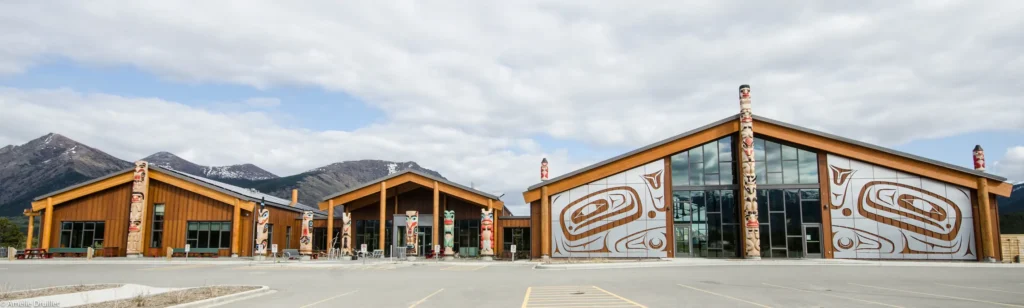
The Carcross Desert has a deep connection to the lives of the Carcross/Tagish First Nation. Long before the Carcross Desert became known to travelers or researchers, it served as an important seasonal gathering area for Indigenous families who lived, hunted, and traveled across this northern terrain.
The dunes and surrounding valleys—now globally recognized as the world’s smallest desert—were once part of a vast network of routes linking lakes, forests, and mountain passes.
For generations, the ancestors of the Carcross/Tagish people used the area for berry gathering, shore fishing, winter trails, and small-game hunting. The warm sands of the Carcross Desert created microclimates that differed from surrounding colder regions, offering unique conditions where plants sprouted early, and certain animals gathered.
Stories, Identity, and Cultural Memory
The smallest desert in the world also carries a layer of spiritual and cultural identity. Oral stories passed down through elders describe the dunes as living parts of the land—moving, shifting, and breathing with the wind. In traditional narratives, the dunes, nearby lakes, and mountain ranges are considered interconnected guardians of the territory.
Read Also: 7 Truths About Authentic North Americans You Need to Know
Table 3: Indigenous Uses of the Carcross Desert Region
| Cultural Aspect | Significance | Notes |
|---|---|---|
| Seasonal Routes | Travel & hunting pathways | Used across generations |
| Plant Gathering | Early-sprouting vegetation | Unique to warm sandy areas |
| Oral Stories | Spiritual meaning | Dunes seen as living entities |
| Community Teaching | Knowledge sharing | Geography used for lessons |
Best Time to Visit the Carcross Desert
Summer (June–August)
During summer, the desert warms up quickly, creating ideal conditions for sandboarding and photography. The Carcross Desert feels surprisingly warm despite its northern location, making this season the most popular for travelers.
Autumn (September–October)
Autumn brings cool breezes, golden colors, and quieter trails across the smallest desert in the world. This is when the Carcross Desert reveals a softer, more scenic side.
Winter (November–March)
Winter blankets the world’s smallest desert in snow, creating a striking contrast between white drifts and dune shapes. While not great for dune activities, the Carcross Desert becomes a breathtaking winter landscape.
Table 4: Seasonal Overview
| Season | Conditions | Best For |
|---|---|---|
| Summer | Warm sand, dry winds | Sandboarding, hiking |
| Autumn | Cool air, colorful scenery | Photography, nature walks |
| Winter | Snow-covered dunes | Scenic viewing, winter photography |
Read Also: Desert Food Web: Uncover the Secrets of Life in Extreme Environments
Key Takeaway
The smallest desert in the world may be tiny, but it packs massive scientific, cultural, ecological, and geological value. Its unusual climate, ancient origins, and rare ecology make it one of the most unique landscapes in North America—and a place that challenges our definition of what a desert truly is.
Conclusion
The smallest desert in the world isn’t just a tiny patch of sand—it’s a geological paradox, a scientific conversation starter, and a natural wonder shaped by ice-age history. As we explore this miniature landscape, we get a fresh reminder that even the smallest parts of nature can spark the biggest curiosity.
If you’re fascinated by unusual landforms, the world’s smallest desert deserves a permanent place on your travel and learning bucket list.
FAQs
1. Why is the smallest desert in the world located in cold northern Canada?
Because glacial sands and dry valley winds create a desert-like microclimate.
2. Can tourists explore the Carcross Desert in the world in all seasons?
Summer and early fall offer the best access for exploring and sports activities.
3. How did the smallest desert in the world get its unusual landscape?
Carcross Desert was formed from ancient glacial lake sediments reshaped by strong valley winds.
4. What makes the Carcross Desert different from classic world deserts?
It’s cold climate, glacial origins, tiny size, and unique plant species.

